

Most social animals cooperate with kin because the genetic interests between relatives are more aligned for kin than for non-kin. The formation of non-kin groups thus stands as a strange exception and can help us achieve a more general understanding of social evolution. I study the evolution of non-kin groups in Taiwan yuhinas. We found most yuhinas formed groups with non-kin. However, kin were more likely than non-kin to be accepted in the groups when group sizes are larger than the most productive sizes. Based on the study of yuhinas, I have also developed a general theory of the evolution of cooperative social groups (Shen et al. 2016, Shen et al. 2017).
Ecology is a fundamental driving force for the evolutionary transition from solitary living to breeding cooperatively in groups. However, the fact that both benign and harsh, as well as stable and fluctuating, environments can favor the evolution of cooperative breeding behavior constitutes a paradox of environmental quality and sociality. Here, we propose a new model – the dual benefits framework – for resolving this paradox. Our framework distinguishes between two categories of grouping benefits – resource defense benefits that derive from group-defended critical resources and collective action benefits that result from social cooperation among group members – and uses insider–outsider conflict theory to simultaneously consider the interests of current group members (insiders) and potential joiners (outsiders) in determining optimal group size. We argue that the different grouping benefits realized from resource defense and collective action profoundly affect insider–outsider conflict resolution, resulting in predictable differences in the per capita productivity, stable group size, kin structure and stability of the social group. We also suggest that different types of environmental variation (spatial vs. temporal) select for societies that form because of the different grouping benefits, thus helping to resolve the paradox of why cooperative breeding evolves in such different types of environments. (Shen et al. 2017).
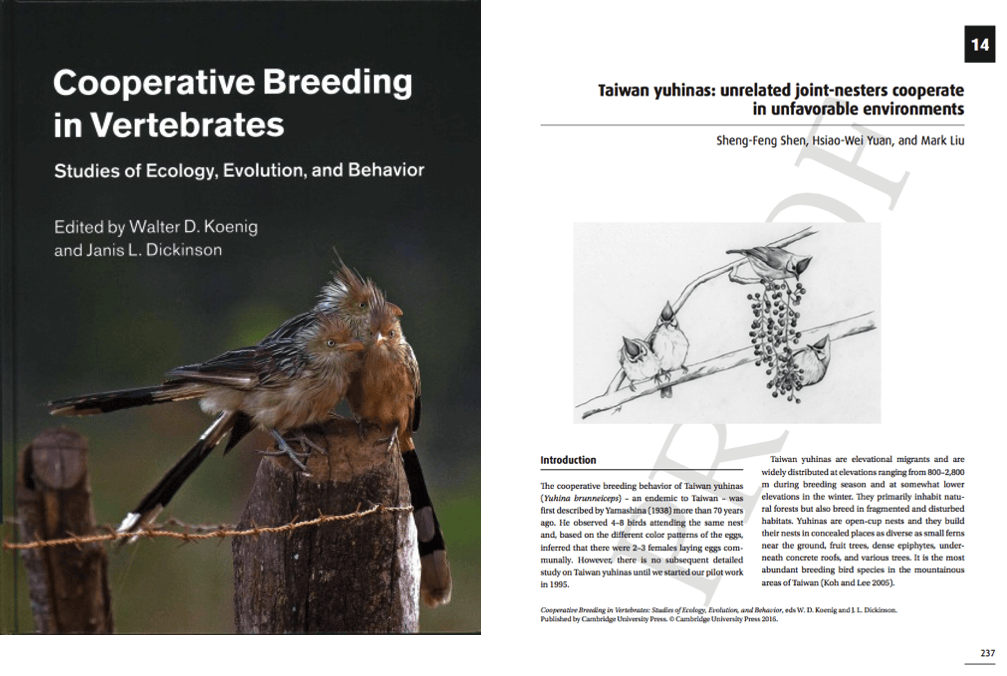
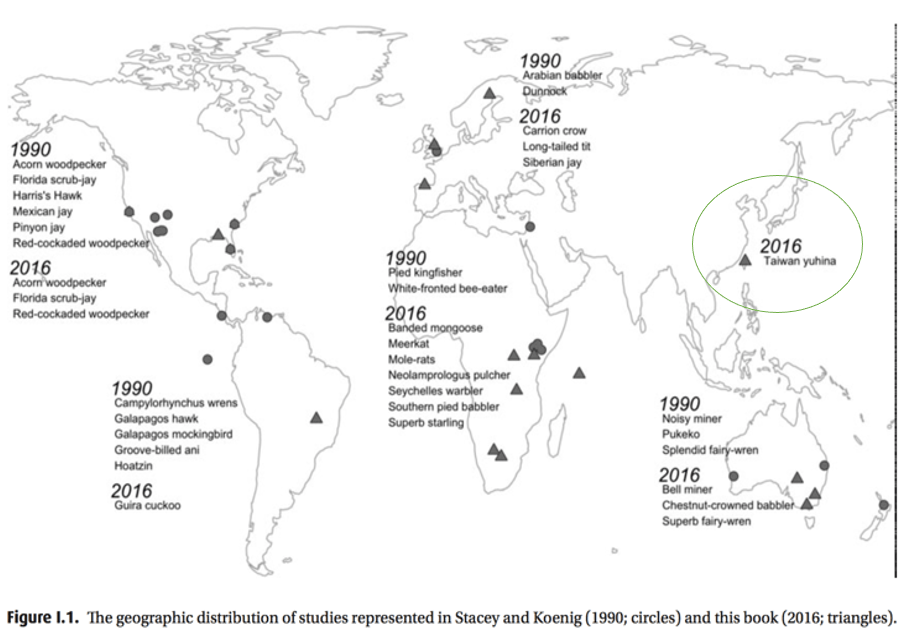
Our Taiwan yuhina study is the only Asian study included in either of the two cooperative breeding volumes edited by Koenig and Dickinson (2004, 2016) (Shen et al. 2016).