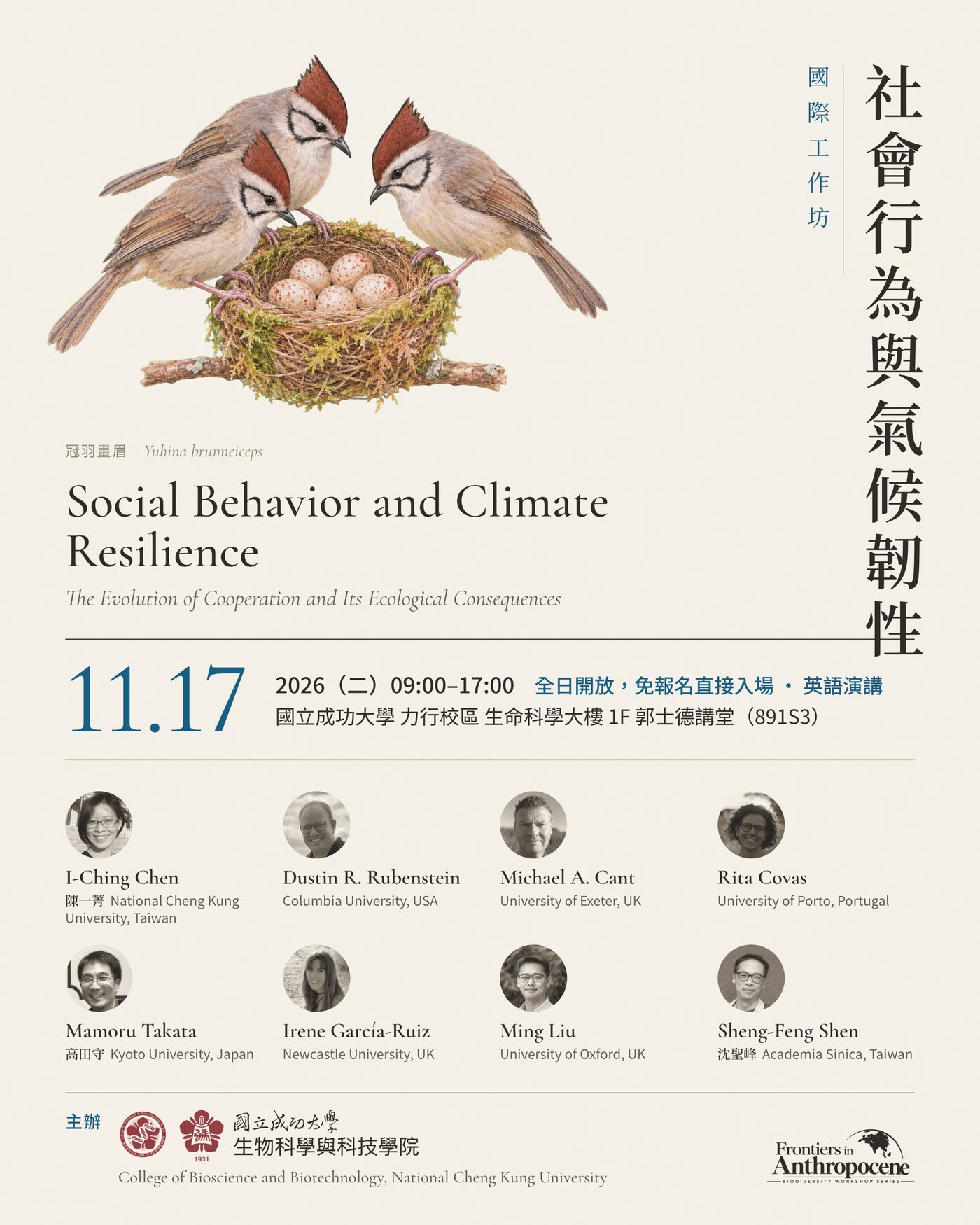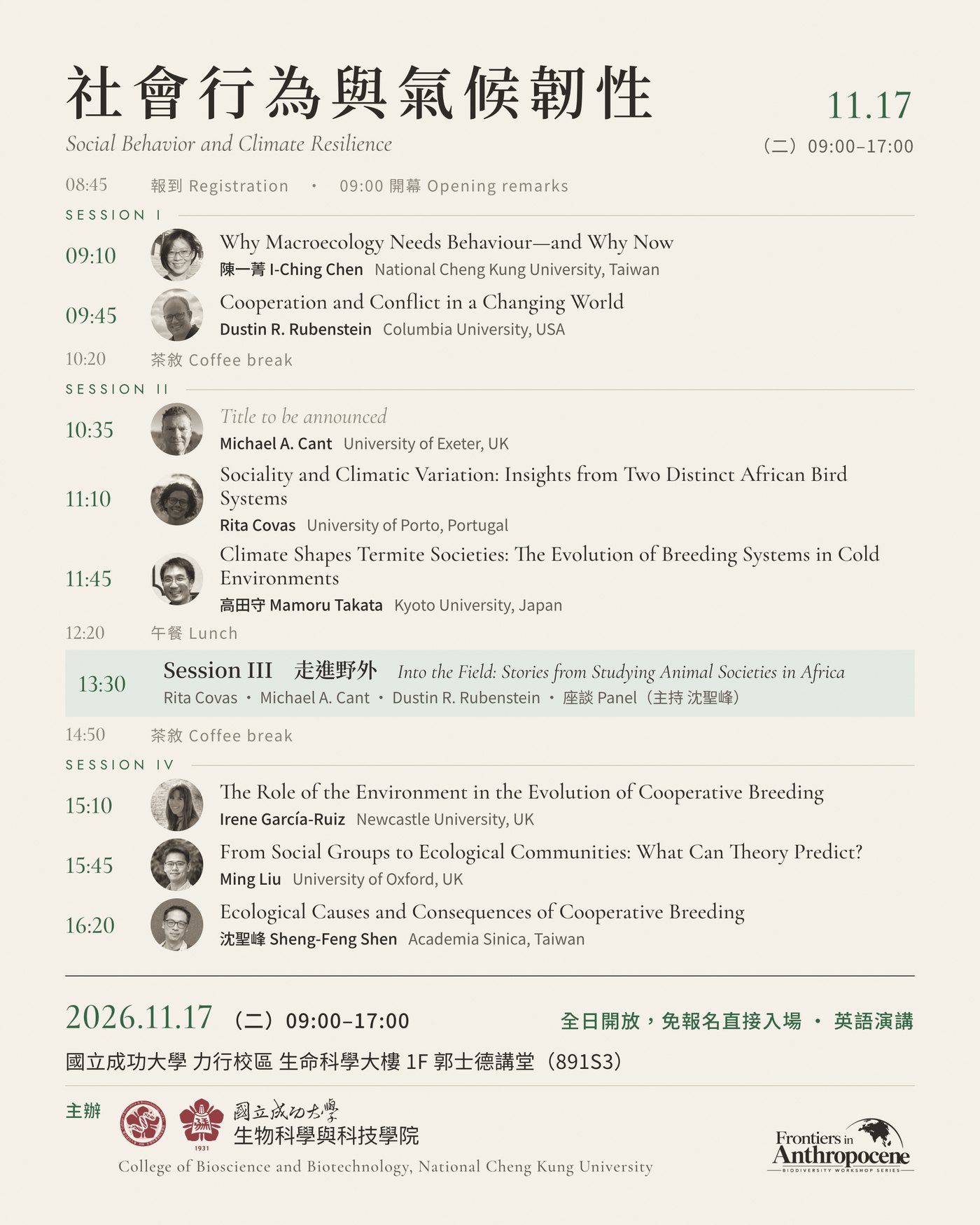
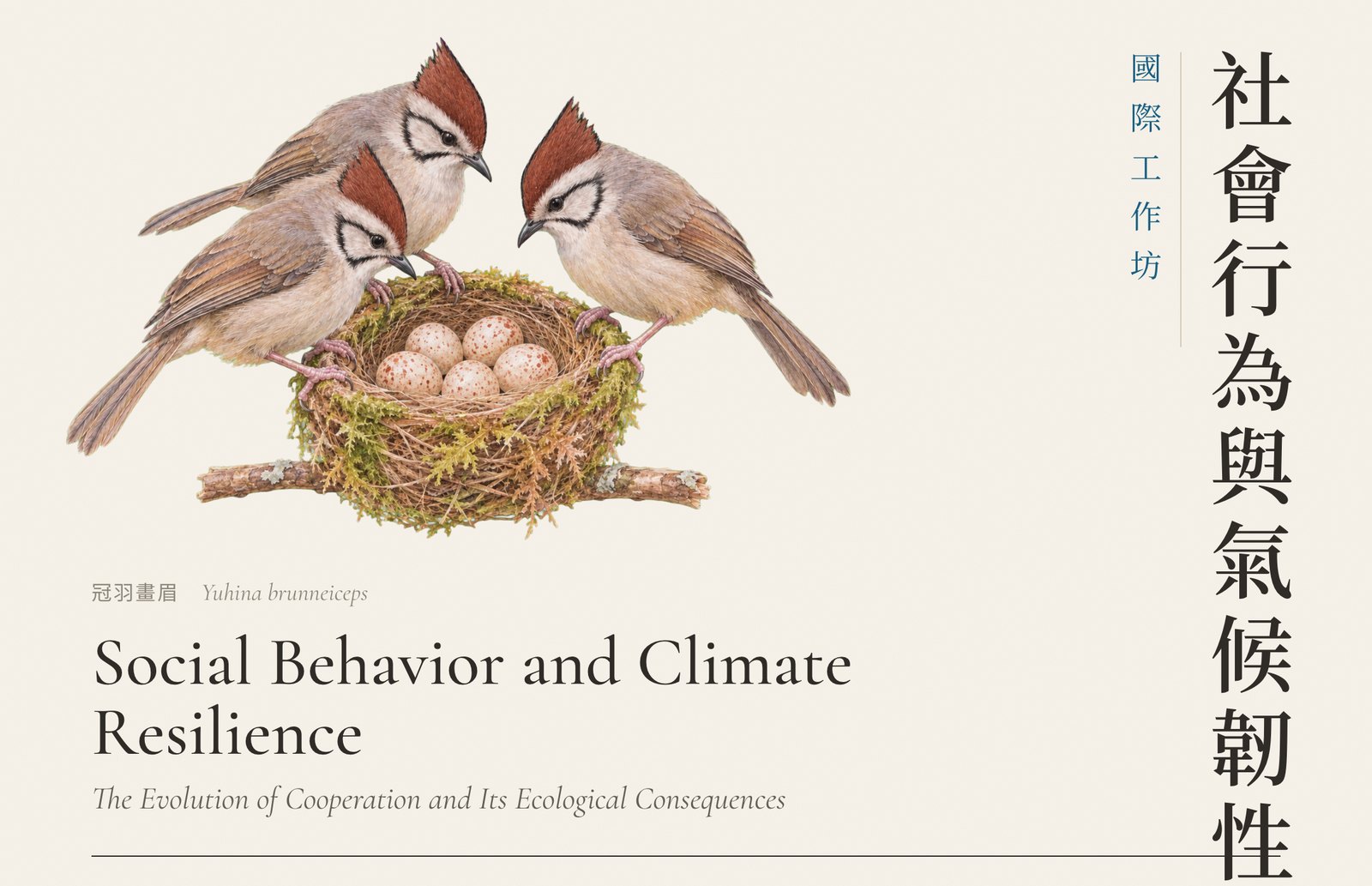
On Tuesday 17 November, eight researchers from universities in the United States, the United Kingdom, Portugal, Japan and Taiwan will speak in one lecture hall at National Cheng Kung University (NCKU) in Tainan. The day is built around one question: as the climate grows more extreme, how will cooperation and social life in animals change, and can cooperation itself help species get through warming?
The Workshop on Social Behavior and Climate Resilience is organised by Sheng-Feng Shen (Academia Sinica) and I-Ching Chen (NCKU) and hosted by NCKU’s College of Bioscience and Biotechnology. It is open to everyone with no registration, so walk in for any session you like. The hall seats about 70, first come, first served, and the talks are in English.
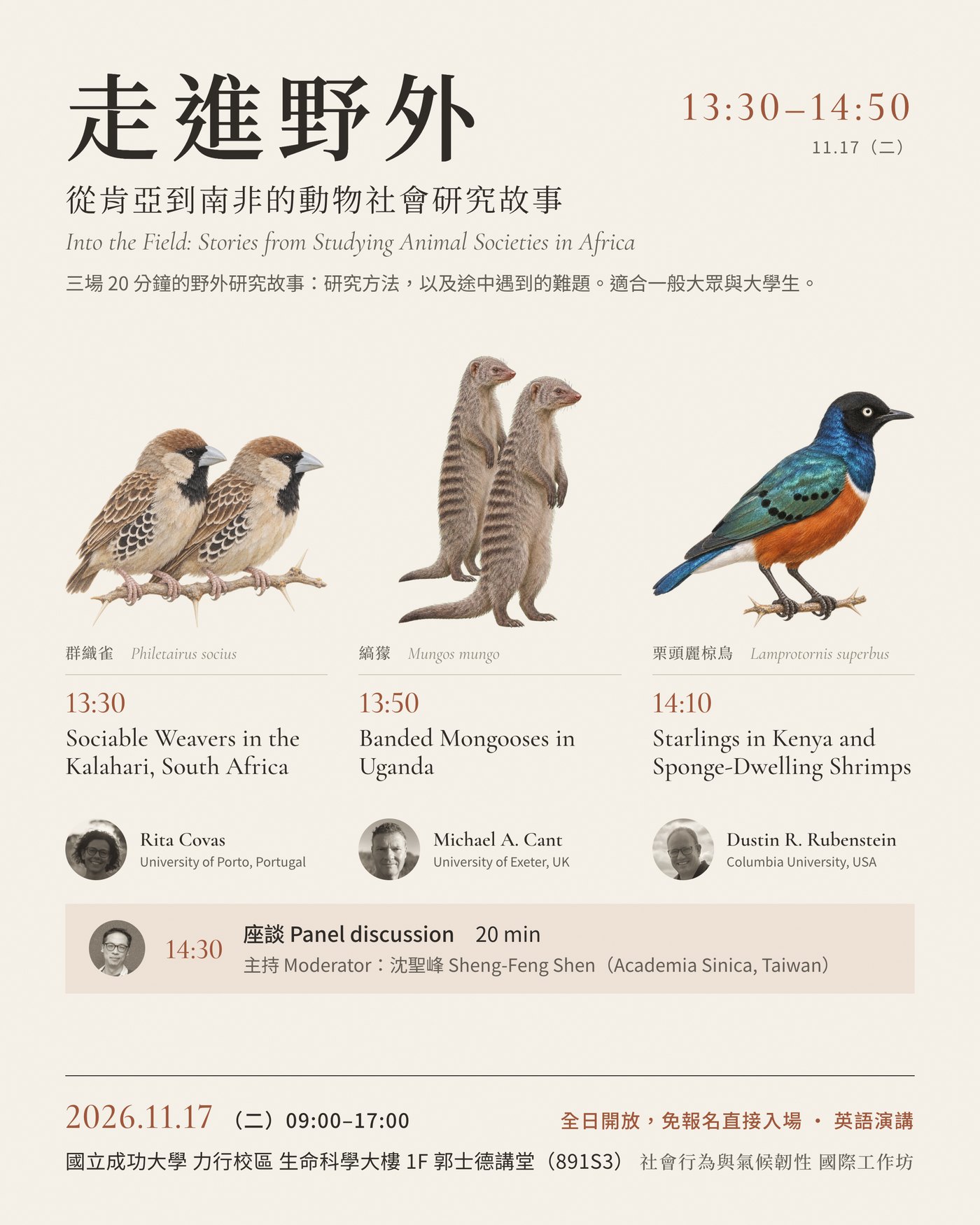
Into the field (13:30–14:50)
This session is meant for the public and for undergraduates. Rita Covas, Michael A. Cant and Dustin R. Rubenstein each have 20 minutes to tell how their field studies in the Kalahari, Uganda and Kenya began and what went wrong along the way, followed by a 20-minute panel moderated by Sheng-Feng. If you can come to only one session, come to this one.
Speakers
- Dustin R. Rubenstein, Columbia University, USA: author of the 12th edition of the textbook Animal Behavior; has followed superb starlings in Kenya since 2001.
- Michael A. Cant, University of Exeter, UK: founded the banded mongoose project in Uganda in 1995, while a PhD student at Cambridge.
- Rita Covas, University of Porto, Portugal: studies sociable weavers in the Kalahari, where breeding success falls in hot weather however many helpers a nest has.
- Mamoru Takata, Kyoto University, Japan: studies termite societies in cold regions and how ageing kings shape the castes of their offspring.
- Irene García-Ruiz, Newcastle University, UK: works on why animals breed cooperatively, in cichlids, cleaner fish and anemonefish.
- Ming Liu, University of Oxford, UK: theory of social immunity and the evolution of complex societies.
- I-Ching Chen, National Cheng Kung University, Taiwan: how species shift their ranges as the climate warms.
- Sheng-Feng Shen, Academia Sinica, Taiwan: cooperation in Taiwan yuhinas and burying beetles, and mountain species under climate change.
When and where
Tuesday 17 November 2026, 09:00–17:00. Lecture hall 891S3 (郭士德講堂), ground floor, Life Sciences Building, Li-Hsing Campus, National Cheng Kung University, Tainan.