Behavioral & social evolution
Cooperation, breeding systems, and social structure, from insects to vertebrates, and the ecological conditions that favor them.
ご参加いただき、ありがとうございました。
非常感謝大家參與第八屆台日生態研討會!從演講與海報前的熱烈討論,到茶敘與餐桌上的交流,謝謝每一位講者、與會者、工作人員與合作夥伴,一起留下這些珍貴的回憶。
讓我們透過閉幕影片,重溫在台北相聚的美好時光。期待下次再見!
第8回台湾・日本生態学ワークショップにご参加いただき、誠にありがとうございました。講演やポスター発表での活発な議論、休憩や食事の時間に交わした会話。登壇者・参加者の皆さま、スタッフ、そして開催を支えてくださったすべての皆さまに、心より感謝申し上げます。
この映像とともに、台北で過ごしたひとときを振り返っていただければ幸いです。またお会いできる日を楽しみにしています!

Taiwan and Japan share mountains that rise steeply from warm seas, summers swept by typhoons, and biotas shaped by the same currents and flyways. We also share a generation of ecologists asking how organisms adapt, cooperate, and shift their ranges as the climate warms.
Welcome to a workshop that keeps on growing. As the long friendship between Taiwan and Japan continues to warm, this meeting — which we still fondly call a “workshop” — has grown with it, well beyond its original scale.
The program reflects that scale. Sessions span the breadth of ecology and evolution — including, but not limited to, behavioral ecology, population and community ecology, climate-change biology, macroecology, and evolutionary genomics. Groups wishing to go further are warmly encouraged to propose a symposium and open a deeper conversation between our two communities.
Six threads running through both countries' research, chosen because they invite direct comparison across the Taiwan-Japan gradient.
Cooperation, breeding systems, and social structure, from insects to vertebrates, and the ecological conditions that favor them.
Genomic architecture of adaptation, including structural variants, supergenes, and the genetics of complex traits.
Elevational and latitudinal gradients, range dynamics, and how diversity is distributed across two mountainous archipelagos.
Range shifts, thermal niches, and the conservation challenges of a warming climate for marine and terrestrial species alike.
Species interactions, coexistence, and the processes that assemble and maintain communities through time.
Models, simulation, and computational approaches that connect mechanism to pattern across scales.
Four plenary lectures, five symposia, five contributed-talk sessions and 56 posters. Explore the full programme for every speaker, title and session.
IBMS 1F lobby
B1C Auditorium
Empirical dynamic modeling towards mechanic understanding, forecasting and early warning for ecosystem dynamics · B1C Auditorium
Interdisciplinary Research Building, 1F
IBMS 1F lobby
A process-based field approach linking classical theory of sociobiology and classical theories of population and community ecology · B1C Auditorium
From plant strategies to ecosystem functioning: insights from litter decomposition · B1C Auditorium
IBMS 1F dining area
Interdisciplinary Research Building, 1F
Island Flight: Rediscovering Taiwan’s Butterflies and Moths
「島嶼飛行-臺灣蝶蛾再發現」 · Guided by Dr. Zong-Yu Shen 沈宗諭
Meet at 17:50 · 1F lobby, Interdisciplinary Research Building
Optional participation; no advance registration required. About the exhibition ↗
Interdisciplinary Research Building, 7F
IBMS 1F lobby
Kyushu University · 2028 · Tomonori Kume 久米朋宣 · B1C Auditorium
B1C Auditorium
IBMS 1F dining area
Four perspectives on ecology and biodiversity. All plenary lectures take place in the B1C Auditorium, IBMS Building.
Add the workshop app directly from Safari or Chrome. Start with the browser buttons shown below.
Look beside the web address, at the top or bottom of your screen. Match your browser to a picture below.
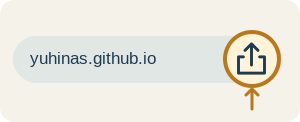
網址旁的分享
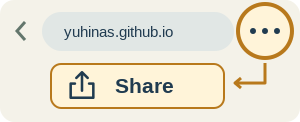
有 ⋯:先按 ⋯ 再按分享
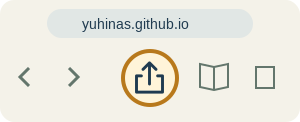
有分享圖示:直接按

網址旁的直向三點
網址旁的分享 → 檢視較多 → 加入主畫面 → 新增
Open the workshop app in Chrome on your iPhone. Tap the Share button at the right-hand end of the address bar.
In the Share sheet, tap the downward arrow labelled View More (檢視較多) to reveal the full list of actions. If the full list is already visible, continue to the next step.
Find and tap Add to Home Screen (加入主畫面). You may need to scroll down the expanded list.
Keep the name TJEW 2026 and tap Add. If Open as Web App appears, leave it on. Open the app from your home screen.
Safari → ⋯(如有)→ 分享 → 檢視較多(如有)→ 加入主畫面
Open the workshop app in Safari, then tap Share . If your Safari has a ⋯ button beside the address bar (compact layout), tap it and then Share. In other layouts, tap Share directly; some versions place it in the Page Menu.
If the Share sheet shows View More, tap it first. Then scroll down and choose Add to Home Screen.
If shown, leave Open as Web App switched on, then tap Add. Open TJEW 2026 from your home screen.
Chrome → ⋮ → 安裝應用程式/加到主畫面
Open the workshop app in Chrome, then tap the ⋮ menu beside the address bar.
Choose Install and create shortcut → Install. Some versions show Install app or Add to Home screen.
Tap Install and follow any on-screen confirmation. Open TJEW 2026 from your home screen or app list.
Actual TJEW app screenshot with illustrated browser controls. Menu labels and positions may vary by device, browser version and language.
Open the app once while connected to the internet and wait for “Offline ready”. The programme, abstracts, saved talks and campus map will then be available offline. Save the PDF booklet separately in Guide.
 On a computer?
Already using the app? Update the app and keep your saved talks ↗
If this page opened inside LINE, Facebook or an email app, open the app link in Safari or Chrome first. On iPhone, first tap View More if the Share sheet is collapsed. In Safari, if Add to Home Screen is still missing, scroll to Edit Actions and add it. You can also use the app directly in your browser.
Browser help: Apple Safari ↗ · Chrome on Android ↗ · Chrome on iPhone ↗
The workshop is held at the B1C Auditorium, Institute of Biomedical Sciences (IBMS) Building, Academia Sinica(中央研究院). Parallel sessions take place in the B1C and B1B Auditoriums of IBMS. Poster sessions are held on 1F and the Saturday banquet on 7F of the adjacent Interdisciplinary Research Building(跨領域研究大樓).
128 Academia Road, Section 2, Nangang District, Taipei 115, Taiwan
Interdisciplinary Research Building · Google Maps ↗
Early-bird rates apply to payments received by 25 September 2026; the regular rate applies afterwards, until registration closes on 1 October 2026. Capacity is limited to 200 participants (50 places reserved for the delegation from Japan), on a first-come, first-served basis.
| Registration | Early birdby 25 Sep | Regularby 1 Oct |
|---|---|---|
| General | NT$1,200 | NT$1,500 |
| Student | NT$800 | NT$1,000 |
| Banquet | Fee |
|---|---|
| General | NT$1,000 |
| Student | NT$500 |
The registration fee includes lunch and coffee on both main days. Payment details are in the registration section below.
Please complete your payment first, then fill out the form below to register and submit an abstract. The abstract deadline is 25 September; registration closes 1 October 2026. Payment is by bank transfer (for registrants from Taiwan) or credit card (for registrants from Japan).
Places are limited by the venue. Registration is capped at 200 participants — 50 places reserved for the delegation from Japan — on a first-come, first-served basis. Early registration is strongly encouraged.
Refund policy. We regret that refunds cannot be provided if you are unable to attend for personal reasons after registering. Thank you for your understanding.
For questions about abstracts, travel, or registration, please email the secretariat.